Wallet PIN vs Seed Phrase: How They Actually Relate
Here is the whole thing in one sentence: a PIN locks only the device in front of you, while the seed phrase decides who really owns the coins. They both look like “passwords,” but their scope is completely different. The PIN stops the person who physically grabs your device. The seed phrase decides whether you can pull the same assets back up on any new device you choose. People who mix these two up either back up too casually, or they get nervous about the wrong layer — agonizing over the PIN while snapping a photo of the seed and dropping it into a phone gallery.
The PIN’s scope: it only works on this device
A PIN (usually six or so digits on a hardware wallet) and a software wallet password are both local access controls. They answer one question only: “Who can use this specific device right now?”
- On a hardware wallet, the PIN is what stops someone who steals or finds the device from seeing balances or confirming a transfer on the screen.
- On a phone or desktop wallet, the password usually unlocks a locally encrypted keystore so the app can move into a “ready to sign” state.
A few points that are easy to miss:
- Changing the PIN does not “move” your assets. Updating the PIN on a hardware wallet does not regenerate the seed; the on-chain ownership does not shift at all.
- Too many wrong PIN attempts will usually wipe the device. What gets wiped is the local key material on that device. The on-chain assets are untouched, and with the seed phrase in hand you simply restore on a fresh device.
- A PIN is useless once it leaves the device. Even if someone learns your PIN, without the physical device they cannot move a single cent.
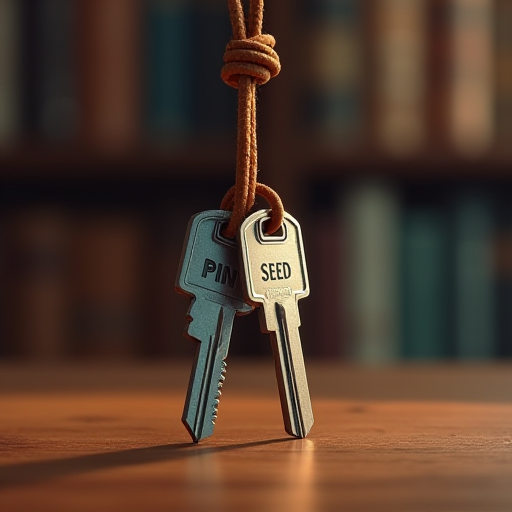
The seed phrase’s scope: across devices, brands, and decades
The seed phrase (twelve or twenty-four English words following the BIP39 standard) does something completely different. It is not really a “password” — it is the human-readable form of the private key itself.
- Anyone, including you, who holds those words can restore the same wallet on a different brand, a different model, or even a competing open-source wallet, fully.
- It does not depend on a vendor. If the company that built your wallet shuts down tomorrow, the seed still works in any compatible wallet.
- It does not depend on time. Words you wrote today still produce the same wallet ten years from now.
Because the seed crosses devices, vendors, and time, it sits at a much higher rank than the PIN — the seed equals ownership, the PIN is just a lock over usage. More concretely:
- Lose the PIN: get a new device, type in the seed, the money is still there.
- Lose the seed: even if you remember the PIN perfectly, the moment the device fails, the assets are gone for good.
- Leak the PIN but keep the device safe: limited damage; the attacker still cannot touch anything.
- Leak the seed: no matter how strong the PIN is, someone on the other side of the planet can drain the wallet.
That asymmetry is what newcomers tend to underestimate. For how to physically back up those words safely, see seed phrase backup methods.
Two scripts when the device is actually lost
Drop those abstract “scopes” into a real moment — the day your wallet device actually goes missing.
Script A: strong PIN, solid seed backup
- You calmly pull out your metal plate or backup card.
- You pick “restore wallet” on a new device and type in the twenty-four words.
- The balance reappears within minutes, and not a single on-chain transfer happened in between.
- The old device, if found, is a brick that wants a PIN and self-wipes after enough wrong attempts.
Script B: strong PIN, but the seed was never properly backed up
- You cannot produce the backup.
- The new device cannot restore the wallet.
- The on-chain assets are still sitting there, but you have lost the only key that can reach them.
- This is the same dead end described in what to do when the seed is lost. Most of the time there is no road back.
Both scripts point to the same truth: the PIN protects the process, the seed protects the outcome. When something actually goes wrong, the seed is what decides if the money is still yours.

A few practical layers of defense
Treating the PIN and the seed as two different tools, instead of two flavors of the same thing, lifts the overall security of the wallet by a clear step. The point is not making either lock “strong enough” on its own — it is that each one minds its own layer.
- Do not use birthdays or the last four digits of your phone number for the PIN. Once a hardware wallet is stolen, attackers usually start guessing those. Most devices allow six to eight digits — pick something meaningful to you but not guessable by others.
- The optional BIP39 passphrase is a “thirteenth word.” It stacks on top of the seed and has nothing to do with the PIN, acting like an extra password that lives only in your head. The trade-offs are explored in the passphrase as extra protection.
- Keep the seed permanently offline. No photos, no cloud, no messenger apps, no typing it into any internet-connected device.
- Should you tell a trusted person your PIN? Ideally no. PIN plus seed equals full control; even with someone you trust, split who knows what so a single leak does not equal full access.
- If you suspect the PIN was glimpsed, change it. If you suspect the seed was seen, you must create a new wallet and move the assets out. Those two responses are not in the same league of urgency; the playbook for a suspected seed leak is in suspected seed leak response.
In daily life this is not complicated. The device and the PIN are what you actually touch; the metal plate you almost never look at is what determines whether you sleep well. A healthy habit is to check the metal plate once or twice a year on a quiet afternoon — confirm it is still legible, then put it back. Do not bring it near any connected device, do not photograph it. That tiny ritual is the cheapest way to make sure the backup is still alive.
One more corner people skip — inheritance. If something happens to you tomorrow, can your family lawfully and calmly reach those assets? That goes beyond a single device and deserves its own household-level plan.
Two locks, two completely different threats
The PIN defends against “someone has my device today” — short-term, close-range, physical. The seed defends against “can I still prove these coins are mine ten years from now” — long-term, cross-device, ownership-level. They are not two versions of the same lock. They are two locks, each guarding its own segment. Once that lands, your backup priorities and your reaction speed both naturally fall into the right place.
This article is educational and is not investment advice; follow your wallet vendor’s official documentation for specific procedures.
This article is for education only and is not financial advice. Crypto is volatile and risky — only ever risk what you can afford to lose.