Private Key, Public Key, Address, Seed Phrase: How Do They Relate?
Almost everyone new to crypto wallets gets tangled up in four words: private key, public key, address, seed phrase. They all sound related to “keys” and “accounts” and are interconnected, so they often get conflated. In fact, once you sort out their derivation relationship, you can immediately tell which one you can hand out freely and which, once leaked, means losing all your assets.
Here’s an overview first, then a breakdown of each.
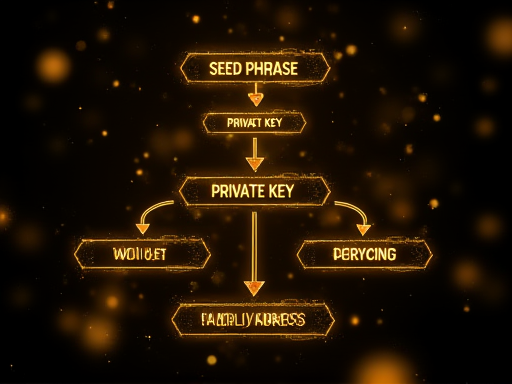
They form a derivation chain
The four are not parallel — they are generated one layer from the next, top down:
Seed phrase → private key → public key → address
- Seed phrase: usually 12 or 24 English words, the “ultimate source” of everything. From it, all the private keys below can be derived.
- Private key: a long string of characters, the real “signing authority.” Whoever holds the private key can move the corresponding assets.
- Public key: derived from the private key through a one-way mathematical operation, and can be public; it’s used to verify signatures but cannot be reversed back into the private key.
- Address: the public key run through another operation and compressed into a shorter string — your external “receiving account.”
The key word is “one-way”: you can compute all the way from seed phrase to address, but in reverse, you cannot derive the public key from the address, the private key from the public key, or the seed phrase from the private key. This irreversibility is the bedrock of wallet security. For a more systematic look at backups, see how to keep your seed phrase and private key safe.
Remember them with a set of analogies
Abstract concepts get easy once mapped to everyday life. Picture your wallet as a locked mailbox:
| Concept | Analogy | Can it be public? |
|---|---|---|
| Address | The mail slot (street number) | Yes — you must give it to receive |
| Public key | A “seal sample” for verifying signatures | Can be public; ordinary users rarely touch it directly |
| Private key | The only key that opens the box and takes what’s inside | Absolutely not — never give it to anyone |
| Seed phrase | The “master template” that can cut that key | Absolutely not — never give it to anyone |
So you can safely send your address to others to receive funds, like telling someone your street number; but the private key and seed phrase are the key itself and the key’s master template — give them away and the other party can take everything in the box, with no “report lost” mechanism whatsoever.
The most commonly confused points
The traps beginners fall into nearly all stem from not separating this derivation chain:
- “If I give someone my address, can I be robbed?” No. The address is public info for receiving; at most others can send funds in — they can’t take the coins out.
- “Are the seed phrase and private key the same thing?” Not exactly. The seed phrase is the higher-level “master template”; one seed phrase can derive many private keys/addresses. So the seed phrase’s security level is higher than a single private key’s.
- “If I switch wallet apps, will my assets be lost?” No. Asset records live on the blockchain, independent of any app. As long as you keep your seed phrase safe, importing it into any compatible wallet lets you manage the same assets again — which is exactly why fake wallet apps target your seed phrase.

Why one seed phrase can manage so many addresses
Many wonder: I only wrote down 12 words, yet my wallet holds several coins and several addresses — how are they all under this one seed phrase? The answer lies in the “hierarchical deterministic wallet” design: the seed phrase first generates a “master seed,” then, through a fixed algorithm, branches out like tree limbs to derive almost endless private keys by index, each corresponding to an address.
This yields two very practical conclusions:
- One backup covers everything: you only need to safely keep that one seed phrase to secure all addresses derived from it, with no separate private-key backup per address.
- You can split holdings across addresses: under the same seed phrase, you can generate multiple addresses and separate long-term storage from everyday interaction — the long-term one never connecting to any site, the everyday one holding only small amounts. This split, used alongside the difference between hot and cold wallets, lowers risk further.
It also reminds you in reverse: the value of a seed phrase equals the sum of all assets across the addresses under it, so its protection level must be the highest.
Why this chain dictates your security habits
Once you understand the derivation, many security tips stop being “someone told me to” and become logic you can reason out yourself:
- Keep the seed phrase offline: as the ultimate source, once it leaks, the assets of all addresses below fall at once.
- Never enter a private key into a webpage: any page asking you to fill in a private key or seed “to verify/unlock” aims to steal your signing authority — the same logic as approval phishing.
- The address can be reused and shared publicly: it was designed to be public.
- Always check what you sign: every signature you make with your private key exercises the power at the bottom of this chain — be sure of what you’re signing.
One line to close
It’s fine if you can’t memorize a pile of terms — just grasp one through-line: the address is the street number, you can give it; the private key and seed phrase are the keys, giving them away gives away your assets. Engrave “which can be shared, which cannot” into your instincts, and you’ve already avoided most of the traps that come from confusing these concepts. When unsure about other terms, flip through the crypto glossary anytime.
This article is educational and does not constitute investment or security advice. Any request for your private key or seed phrase should be treated as a scam.
This article is for education only and is not financial advice. Crypto is volatile and risky — only ever risk what you can afford to lose.